ColdFusion++ Christmas Campaign: Catching a Coordinated Callback Calamity
This report analyzes a focused holiday exploitation campaign where a single Japan attributed network-based actor leveraged 10+ CVEs and OAST callbacks to target Adobe ColdFusion servers during peak Christmas downtime. This was part of what appears to be a broader initial access broker campaign.
coldfusion
projectdiscovery
interactsh
rce
iocs
detection engineering
cybersecurity
Author
hrbrmstr
Published
December 26, 2025
UPDATE: Further analysis revealed the ColdFusion campaign represents a small fraction of a much larger operation. The two primary IPs (134.122.136.119, 134.122.136.96) generated over 2.5 million requests targeting 767 distinct CVEs across 47+ technology stacks, using nearly 10,000 unique Interactsh OAST domains. This appears to be a broad, well-coordinated initial access broker campaign. Details in the Expanded Campaign Scope section below.
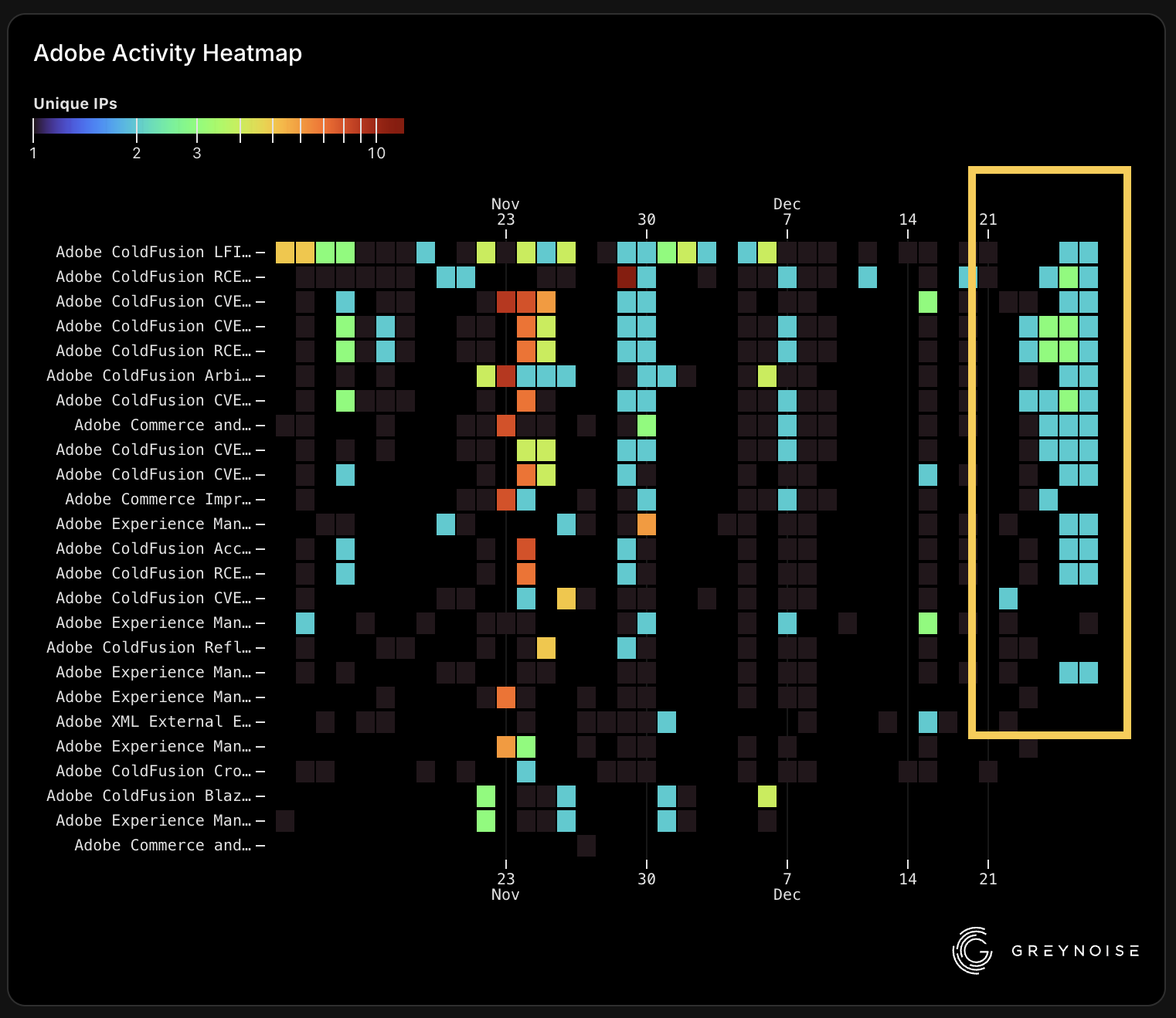
GreyNoise observed a coordinated exploitation campaign targeting Adobe ColdFusion servers over the Christmas 2025 holiday period. The attack appears to be a single threat actor operating from Japan-based infrastructure (CTG Server Limited). This source was responsible for ~98% of attack traffic, systematically exploiting 10+ ColdFusion CVEs from 2023-2024.
The campaign leveraged ProjectDiscovery Interactsh for out-of-band callback verification, with JNDI/LDAP injection as the primary attack vector. The deliberate timing during Christmas Day (68% of traffic) suggests intentional targeting during reduced security monitoring periods.
The dominant threat actor operates from two IPs on CTG Server Limited, a Japan-based hosting provider.
IP Address
Requests
Percentage
ASN
134.122.136.119
3,188
53.7%
AS152194
134.122.136.96
2,683
45.2%
AS152194
Behavioral Indicators: - Automated scanning with 1-5 second request intervals - Both IPs operated concurrently 41% of the time (coordinated infrastructure) - Cycled through 11 distinct attack types per target - Shared Interactsh session (subdomain prefixes d56*/d57*)
Secondary Actors
IP Address
Organization
Country
Requests
Notes
23.234.85.20
tzulo, inc.
Canada
34
Double-encapsulated traffic (VPN)
38.225.206.87
Kennies Star India
India
12
Paired with .88, identical patterns
38.225.206.88
Kennies Star India
India
11
Paired with .87, identical patterns
172.81.132.99
DataWagon LLC
United States
7
—
172.68.119.26
Cloudflare, Inc.
Japan
3
CF-proxied traffic
162.159.110.4
Cloudflare, Inc.
Japan
2
CF-proxied traffic
CTG Server Limited (AS152194) Background
CTG Server Limited is a Hong Kong-registered hosting provider operating AS152194. The network controls approximately 201,000 IPv4 addresses across 672 prefixes despite being only about one year old.
Relevant OSINT findings:
Silent Push (May 2025): Identified AS152194 as the top ASN hosting phishing domains in the FUNNULL CDN infrastructure, which targeted luxury brands including Chanel, Cartier, LVMH, and Tiffany.
BGP.HE.NET: AS152194 announces bogon routes, which is typically a red flag for network hygiene issues.
CleanTalk: Multiple IP ranges within AS152194 appear on spam blacklists.
The combination of Hong Kong jurisdiction, rapid IP space acquisition, and documented abuse associations suggests this provider operates with limited abuse enforcement.
Targeted Vulnerabilities
The campaign exploited the full spectrum of 2023-2024 ColdFusion vulnerabilities:
CVE
Type
Requests
Generic RCE
Remote Code Execution
1,403
Generic LFI
Local File Inclusion
904
CVE-2023-26359
Deserialization RCE
833
CVE-2023-38205
Access Control Bypass
654
CVE-2023-44353
Remote Code Execution
611
CVE-2023-38203
Remote Code Execution
346
CVE-2023-38204
Remote Code Execution
346
CVE-2023-29298
Access Control Bypass
342
CVE-2023-29300
Remote Code Execution
176
CVE-2023-26347
Access Control Bypass
171
CVE-2024-20767
Arbitrary File Read
146
CVE-2023-44352
Reflected XSS
8
Payload Analysis
Attack Distribution
Payload Type
Count
Percentage
Purpose
JNDI/LDAP Injection
189
80%
CVE-2023-26359 exploitation
WDDX Deserialization
28
12%
JdbcRowSetImpl gadget chain
Path Traversal/LFI
10
4%
Credential harvesting
JSP Code Injection
6
3%
CVE-2018-15961 verification
Command Injection
1
<1%
Direct RCE
JNDI Injection Details
The primary attack vector uses WDDX deserialization to trigger JNDI lookups:
The ColdFusion activity described above represents approximately 0.2% of the total scanning operation from these two IPs. Analysis of the full dataset reveals a comprehensive vulnerability reconnaissance campaign.
Full Campaign Statistics
Metric
ColdFusion Campaign
Full Campaign
Total Requests
5,940
2,540,552
CVEs Targeted
10+
767
Attack Signatures
12
1,288
JA4H Fingerprints
5
4,118
OAST Domains
190
~10,000
CVE Coverage by Year
The 767 targeted CVEs span from 2001 to 2025:
Year
Unique CVEs
Requests
2024
142
33,744
2023
107
29,762
2022
112
49,148
2021
99
46,385
2020
43
24,552
2019
41
29,551
2018
58
53,623
2017
19
25,987
2010-2016
80
109,169
Pre-2010
13
17,114
2025
51
11,468
Top Targeted CVEs
CVE
Requests
CVE-2022-26134 (Confluence OGNL)
12,481
CVE-2014-6271 (Shellshock)
8,527
CVE-2016-6195 (vBulletin SQLi)
5,604
CVE-2002-1131 (SquirrelMail XSS)
5,536
CVE-2013-2251 (Struts 2 RCE)
5,510
CVE-2013-2134 (Struts 2 OGNL)
5,284
CVE-2010-2035 (Joomla LFI)
5,148
CVE-2017-10271 (WebLogic)
4,836
CVE-2022-47945 (ThinkPHP LFI)
4,784
CVE-2018-11776 (Struts 2 RCE)
4,298
Technology Targets
The campaign targeted 47+ distinct technology stacks:
Category
Technologies
Requests
Java Application Servers
Tomcat, WebLogic, JBoss, GlassFish
132,113
Web Frameworks
Apache, Struts, Spring, ThinkPHP
91,253
CMS Platforms
WordPress, Joomla, Drupal, vBulletin
72,711
Atlassian Products
Confluence, Bitbucket
19,494
Network Devices
D-Link, Cisco, Netgear, TP-Link, Zyxel, F5
36,355
Surveillance Systems
Dahua, Hikvision
7,636
Monitoring Tools
Nagios, Zabbix, Grafana, Kibana
11,507
Enterprise Applications
SAP, Zoho, ColdFusion, Oracle
35,613
Attack Category Distribution
Category
Unique Tags
Requests
Percentage
Reconnaissance
53
1,431,870
56.4%
CVE Exploits
776
434,984
17.1%
LFI/Path Traversal
38
236,718
9.3%
RCE/Command Injection
190
100,552
4.0%
OAST Callbacks
1
95,402
3.8%
Authentication Attacks
61
88,345
3.5%
SQL Injection
47
19,929
0.8%
File Upload
21
13,293
0.5%
SSRF
17
9,270
0.4%
Operational Characteristics
The 4,118 unique JA4H fingerprints and ~10,000 OAST domains suggest:
Template-based scanning (likely Nuclei or similar)
Per-target or per-vulnerability callback tracking
Automated payload rotation
Systematic coverage of the vulnerability landscape